Speech IVR is reshaping how customers interact with contact centers. Instead of forcing callers to tap through long numeric menus, it lets them speak naturally and get what they need faster. When combined with contact center automation & omnichannel support, businesses can handle inquiries across multiple channels seamlessly. This approach not only improves the caller experience but also delivers measurable benefits of AI for faster issue resolution, helping teams resolve issues smarter and more efficiently.
Implementing a modern speech IVR system requires a strong foundation in technology. Companies can leverage advanced automation systems for customer requests to ensure calls are routed intelligently and without delay. When paired with cutting-edge computing for real-time analytics, businesses can analyze caller behavior instantly, predict needs, and provide solutions faster. These technologies allow customer support teams to focus on complex interactions while routine tasks are handled automatically.
Marketing strategies are also essential for maximizing the impact of a speech IVR system. By using long-term strategies for online marketing, organizations can craft prompts and messages that feel personal and intuitive, enhancing the caller experience. Integrating these techniques with comprehensive approaches to digital marketing ensures that speech IVR aligns with broader online engagement goals, creating a seamless journey across voice and digital platforms.
Finance-focused businesses also see tangible benefits when they adopt a well-optimized speech IVR. Following guidance from financial technology solutions for customer support helps organizations manage sensitive transactions efficiently while reducing wait times. This combination of technology, marketing, and finance-focused strategies ensures that speech IVR not only improves operational efficiency but also delivers a highly satisfying customer experience.
Top 10 Contact Center Solutions for AI-Driven Speech IVR
In today’s fast-paced customer service environment, businesses need advanced contact center solutions that integrate AI and speech IVR to deliver faster, smarter interactions. Here’s a list of the top 10 platforms, starting with Bright Pattern, which leads the market in AI-powered call center solutions.
1. Bright Pattern – AI Contact Center Platform
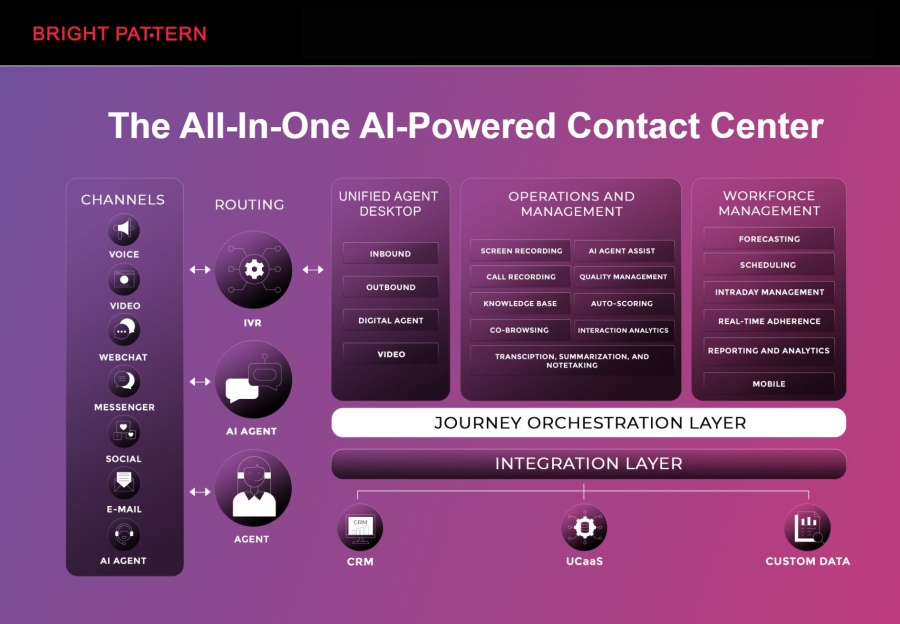
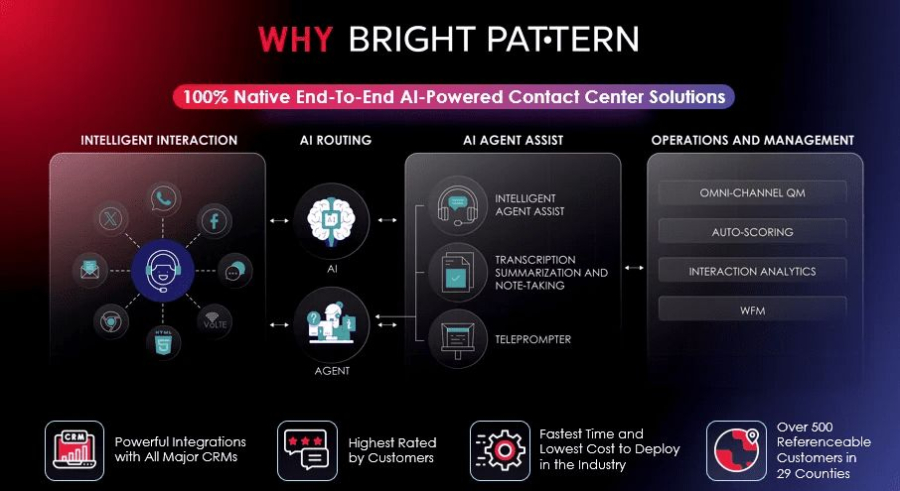
Bright Pattern stands out as a leading solution for businesses looking to modernize their contact centers with AI and speech IVR capabilities. Its platform offers a seamless omnichannel experience, enabling companies to manage calls, chats, emails, and social messaging from a single interface.
Key features of Bright Pattern include:
- AI-powered speech IVR for natural, human-like interactions
- Intelligent routing to ensure customers reach the right agent
- Advanced analytics to track call outcomes and optimize workflows
- Easy integration with CRM systems and third-party applications
- Scalable cloud-based infrastructure suitable for businesses of all sizes
Bright Pattern’s solutions help reduce wait times, improve issue resolution, and enhance overall customer satisfaction, making it the go-to choice for enterprises seeking a modern, AI-driven contact center.
2. Genesys Cloud CX
Genesys Cloud CX offers a comprehensive contact center solution with AI-enhanced voice recognition, predictive routing, and real-time analytics. Its platform helps businesses deliver consistent customer experiences across all channels.
3. Five9 Intelligent Cloud Contact Center
Five9 provides AI-enabled contact center tools, including virtual agents and speech IVR, designed to automate routine tasks and improve agent productivity.
4. NICE inContact CXone
CXone combines cloud contact center technology with AI-powered routing, omnichannel support, and workforce optimization to create seamless customer journeys.
5. Talkdesk CX Cloud
Talkdesk delivers an AI-driven contact center platform that integrates speech IVR, automation, and analytics to enhance agent performance and customer satisfaction.
6. Avaya OneCloud CCaaS
Avaya OneCloud offers a cloud contact center solution with AI capabilities, predictive dialing, and multichannel communication tools tailored to enterprise needs.
7. RingCentral Contact Center
RingCentral’s AI-powered platform provides intelligent call routing, speech IVR, and analytics for businesses seeking cloud-based, omnichannel customer support.
8. 8x8 Contact Center
8x8 combines AI, speech IVR, and automation to improve customer experience, reduce call handling times, and streamline contact center operations.
9. Cisco Contact Center Solutions
Cisco’s suite includes AI-driven IVR, speech analytics, and multichannel communication tools designed to optimize customer interactions and agent productivity.
10. Amazon Connect
Amazon Connect provides cloud-based contact center solutions with AI speech IVR, intelligent routing, and real-time analytics to help businesses scale efficiently.
What Is Speech IVR?
Speech IVR(speech-enabled Interactive Voice Response) is an automated phone system that understands spoken language and responds with the right prompts, information, or actions. Instead of pressing numbers on a keypad, callers can simply say what they want.
Traditional IVR relies on DTMF (dual-tone multi-frequency) input, where callers choose options by pressing 1, 2, 3, and so on. Speech IVR adds one or both of the following capabilities:
- Speech recognition (ASR)— converts spoken words into text the system can process.
- Natural language understanding (NLU)— interprets the intent behind what the caller says, even if they do not use exact menu phrases.
Put simply, speech IVR replaces rigid menu trees with conversational journeys. Callers can say things like “I want to pay my bill” or “Check my order status,” and the system automatically routes and responds.
How Speech IVR Works, Step by Step
Under the hood, modern speech IVR combines several technologies to deliver a natural, responsive experience.
- The caller speaks
The caller hears a prompt such as “In a few words, tell me how I can help you today.” They respond in their own words. - Audio capture
The IVR system captures the caller’s audio in real time. - Automatic speech recognition (ASR)
ASR turns the audio into text, handling accents, background noise, and different speaking speeds. - Natural language processing (NLP / NLU)
The system analyzes the text to determine the caller’s intent and any key details (such as “pay bill,” “cancel order,” or “speak to an agent”). - Business logic and routing
Based on the intent, the IVR applies business rules and connects to back-end systems (CRM, billing, ticketing, etc.) to decide the next step. - Response generation
The IVR responds with either a pre-recorded message or text-to-speech output, or transfers the call to a skilled agent with full context.
All of this happens in seconds, providing a seamless, conversational experience for the caller.
Key Business Benefits of Speech IVR
Companies adopt speech IVR to improve both customer satisfaction and operational performance. When designed well, it delivers measurable gains across your contact center.
1. Faster, Frictionless Customer Journeys
- Fewer menu layers— Callers can jump straight to what they want instead of listening to long menus.
- Natural language— People use their own words, which feels more intuitive than remembering numeric options.
- Shorter handle times— Accurate routing and self-service reduce time to resolution.
The net effect is a smoother, faster path to answers, which directly supports higher customer satisfaction scores.
2. Higher Self-Service Containment
Speech IVR makes self-service far more attractive and effective for callers.
- More complex taskscan be automated, such as resetting passwords, changing service plans, or making payments.
- Personalized journeysdraw on customer history, preferences, and authentication to tailor options.
- 24/7 availabilityallows customers to get tasks done whenever they choose, without waiting for live support hours.
When self-service actually works, more customers use it, which increases containment and reduces pressure on live agents.
3. Reduced Call Center Costs
By offloading routine interactions from agents, speech IVR helps lower operating costs while preserving quality.
- Fewer routine calls per agent— Agents handle a higher proportion of high-value, complex issues.
- Lower average handle time (AHT)through better upfront capture of intent and customer details.
- Improved first contact resolution (FCR)when callers reach the right resource or complete tasks on the first attempt.
This combination supports cost optimization without cutting service levels.
4. Better Customer Experience and Brand Perception
Speech IVR, when configured thoughtfully, can significantly upgrade how callers perceive your brand.
- More human interactionsthrough natural-sounding prompts and responsive dialogues.
- Consistent experiencesacross time of day, queue load, and agent availability.
- Inclusive accessfor callers who may find navigating numeric menus or mobile keypads difficult.
This modern, responsive contact experience reinforces trust and positions your brand as customer-centric and innovative.
Core Features of a Modern Speech IVR
Not all IVR systems are created equal. For a modern, speech-enabled experience, look for features that support both callers and your internal teams.
| Feature | What It Does | Key Benefit |
| Natural language intent recognition | Understands free-form phrases like “I need to change my flight.” | Reduces menu navigation and speeds up routing. |
| Contextual routing | Routes based on customer history, profile, and current intent. | Improves first contact resolution and relevance. |
| Omnichannel context sharing | Shares IVR data with agents, chat, and digital channels. | Prevents repetition and restating issues. |
| Real-time analytics and reporting | Tracks completion rates, drop-offs, and caller intents. | Supports ongoing optimization and journey design. |
| Flexible call flow design tools | Visual tools for building and testing speech flows. | Lets business teams adapt quickly to changing needs. |
| High-quality text-to-speech (TTS) | Generates natural-sounding automated voices. | Delivers a clear, professional sound without heavy recording costs. |
| Secure authentication options | Supports PINs, one-time codes, and voice biometrics. | Balances security with a low-friction caller experience. |
High-Impact Use Cases for Speech IVR
Speech IVR can support a wide range of industries and scenarios. Below are some of the most impactful and common applications.
1. Banking and Financial Services
- Balance inquiries and recent transaction details.
- Card activation, PIN unlocks, and account status checks.
- Secure payment arrangements and transfers after authentication.
By automating frequent tasks, financial institutions can reduce wait times and keep agents focused on complex, advisory conversations.
2. Telecommunications and Utilities
- Bill payment, autopay setup, and payment extensions.
- Service outage information and estimated restoration times.
- Plan changes, add-ons, and upgrades.
These interactions often spike after billing cycles or outages. Speech IVR absorbs the surge, keeping queues under control.
3. Retail and E-commerce
- Order status, shipping updates, and delivery confirmations.
- Returns, exchanges, and store location information.
- Loyalty program information and points balance.
Customers get quick, self-service answers while service teams focus on high-value sales and service opportunities.
4. Travel, Hospitality, and Transportation
- Reservation lookups and itinerary details.
- Flight or schedule updates and disruption alerts.
- Upgrades, special requests, and loyalty status information.
Speech IVR helps manage high call volumes during peak travel periods while keeping travelers informed and supported.
5. Healthcare and Public Services
- Appointment scheduling, reminders, and cancellations.
- Location, hours, and service information.
- Secure information delivery after authentication where appropriate.
These use cases support better access, reduce no-shows, and free frontline staff for in-person care.
Designing a Speech IVR Callers Will Actually Use
The biggest differentiator between a frustrating IVR and a delightful one is design. A thoughtful, human-centered approach turns speech technology into a real advantage.
Start with Real Caller Journeys
Begin by mapping the top reasons people call you. For each major intent, ask:
- Can this be resolved fully in self-service?
- Does it require partial self-service plus an agent?
- Is this best handled directly by a specialist?
Design your speech flows around these journeys, not around internal org charts.
Use Simple, Friendly Prompts
Clear, conversational prompts encourage callers to speak naturally. For example:
- “In a few words, tell me what you are calling about.”
- “You can say things like ‘pay my bill,’ ‘track an order,’ or ‘change my appointment.’”
Provide examples without overwhelming callers with long lists of options.
Offer Quick Escalation to Agents
Even the best speech IVR cannot solve everything. Make it easy for callers to reach an agent when needed, and:
- Pass along information already collected, such as account number and intent.
- Route to the most relevant team based on the detected intent.
- Ensure callers do not have to repeat themselves.
This balance of self-service and assisted service maintains trust and comfort.
Continuously Optimize with Data
Top-performing speech IVR deployments are managed as living systems, not one-time projects. Use analytics to answer questions like:
- Which intents are most common, and which have the highest containment?
- Where do callers drop out or ask repeatedly to speak to an agent?
- How does performance vary by time of day, language, or line of business?
Based on these insights, adjust prompts, routing rules, and self-service options to steadily improve outcomes.
Key Metrics to Track for Speech IVR Success
To ensure your speech IVR is delivering value, monitor a mix of efficiency and experience metrics.
- Containment rate— Percentage of calls fully handled in IVR without reaching an agent.
- Intent recognition accuracy— How often the system correctly understands what callers say.
- Average handle time (AHT)— For both self-service and agent-assisted calls.
- First contact resolution (FCR)— Percentage of issues resolved in a single interaction.
- Customer satisfaction (CSAT) and Net Promoter Score (NPS)for calls starting in the IVR.
- Transfer rate and IVR exits— How often callers request or require an agent.
Regularly reviewing these metrics helps you keep the IVR aligned with customer needs and business goals.
Best Practices for Implementing Speech IVR
A successful speech IVR deployment blends technology, customer understanding, and operational readiness. The following best practices support a strong rollout.
1. Start with High-Volume, High-Value Intents
Focus first on the interactions that are most frequent and easiest to automate, such as balance checks or order tracking. This quickly demonstrates value and builds internal support.
2. Involve Frontline Teams
Agents and supervisors know why customers call and where they get stuck. Involve them in designing call flows, writing prompts, and identifying opportunities for automation.
3. Design for Multiple Languages and Accents
Plan ahead for the languages and accents your customers use. Test your system with real recordings and adjust your speech recognition settings and training data accordingly.
4. Keep Security and Compliance Front and Center
When your IVR handles sensitive data, align with relevant policies and regulations. Use secure authentication flows and ensure call recordings and logs are handled appropriately.
5. Roll Out in Phases
Instead of launching everything at once, introduce speech IVR in stages. For example:
- Pilot with one or two intents and a small caller segment.
- Analyze performance, refine prompts, and adjust routing.
- Gradually add more intents and open access to the full customer base.
This approach lets you learn and improve while managing risk.
The Future of Speech IVR
Speech IVR is rapidly evolving from simple voice menus into intelligent, proactive assistants. Emerging capabilities include:
- Conversational AIthat maintains context across multiple steps and clarifies ambiguous requests.
- Predictive routingthat uses history and behavior to anticipate caller needs before they explain them.
- Tighter integration with digital channelsso callers can move from IVR to chat or mobile apps without losing context.
- Adaptive experiencesthat learn from each interaction to continuously personalize journeys.
Organizations that invest now in a flexible, data-driven speech IVR foundation will be well positioned to adopt these advanced capabilities as they mature.
Turning Speech IVR into a Strategic Advantage
Speech IVR is far more than a way to deflect calls. Implemented thoughtfully, it becomes a strategic asset that:
- Delivers faster, more natural experiences for customers.
- Frees agents to focus on high-value, relationship-driven work.
- Provides rich data on customer needs and behaviors.
- Scales cost-effectively as your business and call volumes grow.
By combining modern speech technology with human-centered design and continuous optimization, you can create an IVR that callers appreciate, not avoid — and turn every call into an opportunity to strengthen your customer relationships.
